
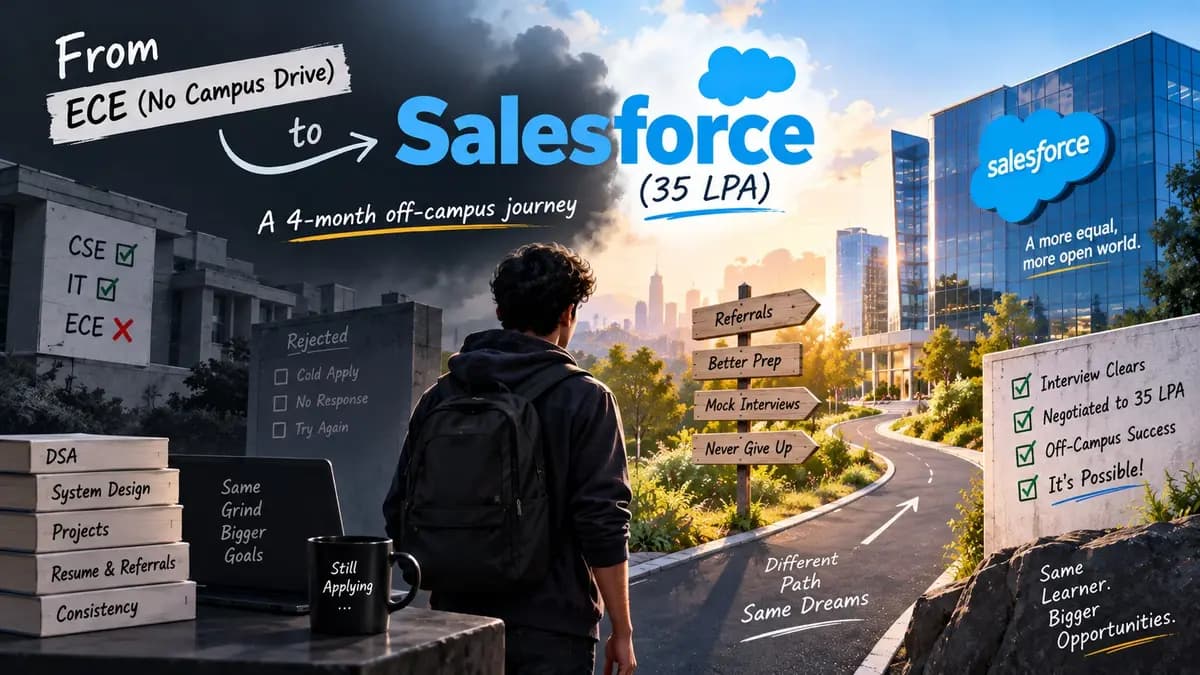
My college's placement policy that year restricted certain companies to CSE and IT branches only, and I was in ECE. Salesforce, along with a couple of other product companies I actually wanted, never even opened applications for my branch during the campus season. I watched classmates from CSE go through interview loops for roles I was arguably more prepared for, thanks to a couple of personal projects and a decent DSA foundation, while my own placement options got funneled into a handful of core-electronics companies I had zero interest in.
I graduated without an offer I wanted, which was its own kind of demoralizing given how much effort I'd put into interview prep that never got used. The four months after graduation were the actual grind, not campus season, applying cold, reaching out to alumni on LinkedIn, and slowly accepting that "off-campus" wasn't a lesser path, just a slower and lonelier one.
How I Prepared During the Gap Months After Graduation
Those four months were unstructured in a way campus prep never is. No placement cell deadlines, no batch of classmates going through the same rounds to compare notes with, just me, a study plan I built myself, and a slowly draining sense of urgency as months passed without an offer.
I split the time roughly into two phases. The first two months were DSA-heavy, working through arrays, trees, and graphs systematically instead of randomly picking problems, since without campus deadlines forcing a specific timeline I needed my own structure to avoid drifting. The last two months I added basic low-level design, class design for common systems like a parking lot or a rate limiter, since I'd read enough Salesforce interview accounts to know SDE-1 loops there sometimes included a design round even at that level.
I also spent real time on my two personal projects, making sure I could talk through design decisions confidently rather than just listing technologies used, since without a campus brand behind my resume, the projects were the main thing making my application stand out at all.
Applying to Salesforce: A Referral After Months of Cold Applications
I'd sent out enough cold applications by month three that I'd stopped expecting replies from most of them. What actually worked was a message to a Salesforce engineer I found through a mutual college alumni group, someone I'd never met, who agreed to refer me after a short LinkedIn conversation about my projects. The recruiter reached out about two and a half weeks later, which felt like a long wait at the time but was honestly faster than several of my other cold applications that never got a response at all.
Inside Salesforce's Off-Campus Interview Rounds
The process opened with a technical phone screen, a single coding problem on merging overlapping intervals, which I solved cleanly and then spent the remaining time discussing my final-year project's architecture. That round felt encouraging enough that I allowed myself a small amount of hope for the first time in months.
The virtual onsite loop had three rounds. The first was a coding round, a tree-based problem involving finding the lowest common ancestor, which I'd practiced enough variations of that I moved through it steadily. The second round is where I actually stumbled. It was a low-level design question, design a basic notification system that could support multiple channels like email and SMS. I started strong outlining the core classes, then got stuck trying to decide whether channel-specific logic belonged inside each notification type or in a separate dispatcher class, going back and forth out loud for almost a minute before the interviewer gently asked, "what tradeoff are you actually weighing right now?" Saying it out loud, that I was worried about violating single responsibility versus over-engineering for a case that might not need that much abstraction, helped me actually commit to a decision, a separate dispatcher, and defend it clearly for the rest of the round.
What actually helped: naming the tradeoff out loud instead of silently flip-flopping between two designs is what turned that stumble into a round I still passed. The interviewer cared more about seeing the reasoning than about which option I picked.
The Culture Round: What Salesforce's "Ohana" Value Actually Means in an Interview
The final round was entirely behavioral, built around Salesforce's stated values, trust, customer success, innovation, and equality, and the Ohana idea of treating colleagues and customers like extended family. The interviewer asked about a time I'd had to rebuild someone's trust after a mistake, and I talked about a group project where I'd missed a deadline that affected two teammates, and how I'd handled the aftermath by over-communicating my remaining timeline rather than avoiding the conversation. She followed up asking what I'd do differently if it happened again, and I said honestly that I'd flag the risk of missing the deadline days earlier instead of waiting until it was unavoidable, which felt like a more useful answer than pretending the mistake had never really been a problem.
The Offer, and the Negotiation That Actually Got Me to 35 LPA
The initial offer call came about ten days after the culture round, and the number was solid but noticeably below what I'd seen similar roles going for based on some research beforehand. I had a second, smaller offer in hand from an earlier application, not nearly as good, but real enough to use as leverage. I told the recruiter directly that I had a competing offer and asked if there was room to revisit the number, expecting some resistance.
There was a week of back and forth, a revised number, then another round of me pushing on the stock component specifically rather than base salary, since that seemed to have more flexibility. The final package landed at 35 LPA total compensation, a meaningful jump from the initial offer, and only happened because I asked directly instead of accepting the first number out of relief that an offer existed at all.
Key Takeaways for Anyone Job-Hunting Off-Campus After Missing Placements
If I were doing this again after missing my campus placement window:
I would start reaching out for referrals from month one instead of relying on cold applications for the first three months. The referral is what actually moved things, not the volume of applications I sent out.
I would practice naming design tradeoffs out loud earlier in my prep, since that skill mattered more in the actual LLD round than knowing one more design pattern by name.
I would negotiate the very first offer I ever get, regardless of how relieved I feel just to have one, since the gap between my initial and final Salesforce number was too large to have left on the table out of politeness.
If you're a few months past graduation without the offer you wanted, still applying and starting to wonder if the moment already passed you by, the mock interviews and resume feedback I used on devsunite.com/resources helped me get comfortable defending project decisions out loud, which is exactly what carried me through that design round stumble.
Frequently Asked Questions About Salesforce's Off-Campus SDE-1 Hiring Process
What does Salesforce's off-campus interview process for SDE-1 look like?In my case it was a technical phone screen, followed by a virtual onsite loop of two coding rounds and one culture/values-based round. One of the coding rounds included a low-level design component even at the SDE-1 level.
Can you still get into a product company months after missing campus placements?Yes. I applied roughly four months after graduating, without a campus placement offer, through a referral I got by messaging a Salesforce engineer directly on LinkedIn.
Is 35 LPA a realistic SDE-1 offer at Salesforce, or does it require negotiation?In my case it required real negotiation. My initial offer was meaningfully lower, and the final 35 LPA package came after I disclosed a competing offer and specifically pushed on the stock component over several rounds of back and forth.
What does Salesforce's culture round actually evaluate?Specific, honest examples of rebuilding trust or handling a mistake, tied to their stated values rather than generic behavioral answers. My interviewer's follow-up question pushed past the story itself into what I'd change if it happened again.
Conclusion
Landing a 35 LPA offer at Salesforce off-campus wasn't about being handed a shortcut around the system that had shut me out during placements. It was four unstructured months of self-driven prep, a referral I had to build myself instead of inheriting from a placement cell, one design round I nearly fumbled by not committing to a decision, and a negotiation I almost didn't push hard enough on. If a branch rule or a missed drive closed a door on you too, that door reopens slower off-campus, but it does reopen.